When it comes to professional engine calibration, the quality of the equipment used to test the vehicle is just as important as the tuning itself.
At Simms Performance, we use a Mainline ProHub AWD hub dynamometer because it provides an extremely controlled, repeatable and direct method of testing a vehicle under load.
Without doubt traditional rolling-road Dyno’s remain a useful tuning tool, but a hub dyno removes several variables associated with tyres, wheel slip and vehicle strapping. For performance and motorsport applications, we believe this gives us a better platform on which to develop an accurate calibration.
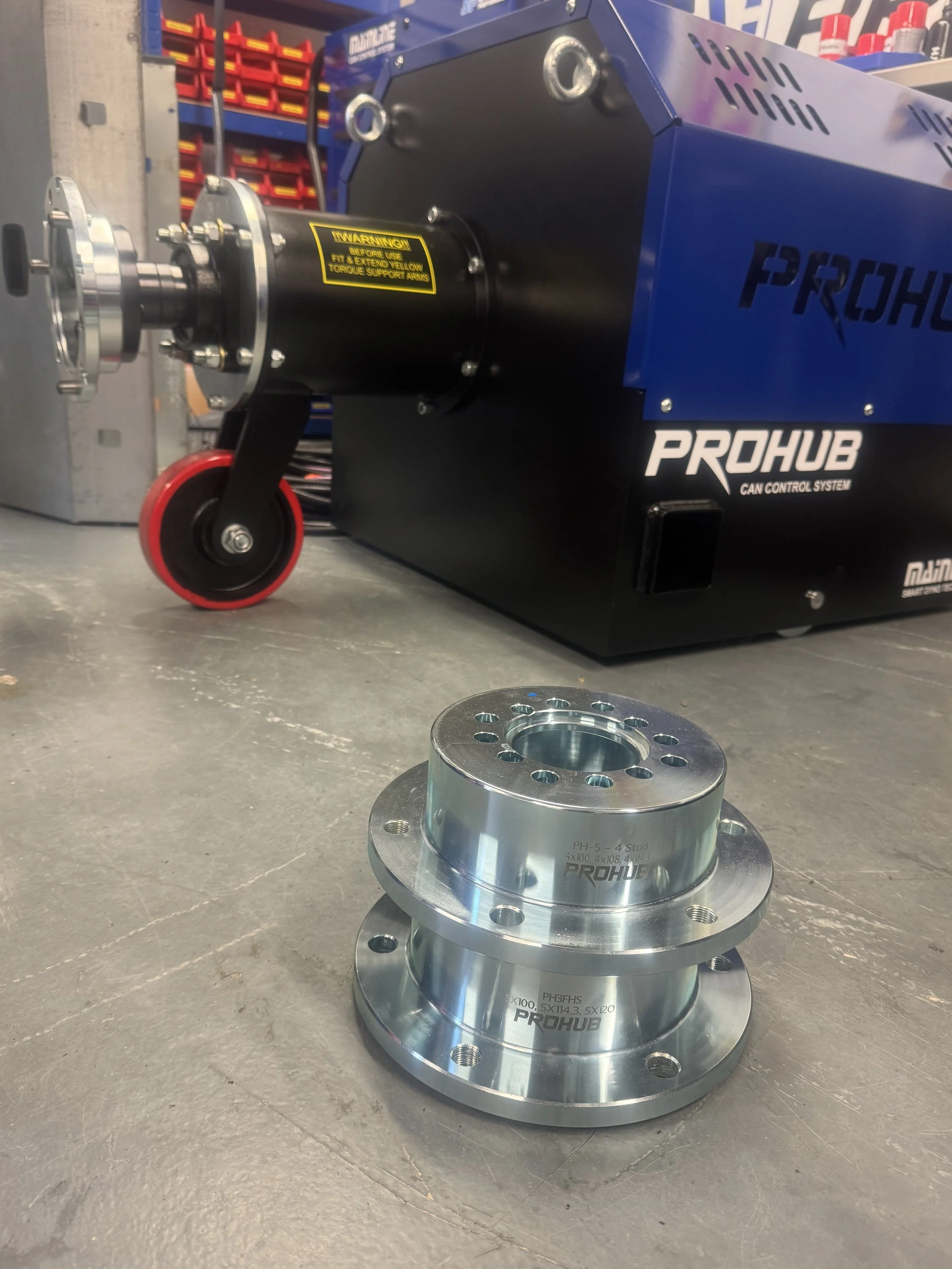
What Is a Hub Dyno?
The fundamental difference is how the vehicle connects to the dynamometer. On a conventional roller dyno, the vehicle’s driven wheels remain fitted and the tyres transmit power into a set of rollers. With a Mainline ProHub, the driven wheels are removed and the Dyno hubs are mechanically connected directly to the vehicle’s hubs. This means the connection between the drivetrain and dynamometer does not depend on the tyre-to-roller interface.
That seemingly simple difference provides some significant advantages.
1. No Tyre Slip
There is no question about the fact that on a hub dyno the biggest advantage is the elimination of tyre slip. Maintaining sufficient tyre/roller traction can become increasingly difficult as power and torque increase. Variables such as tyre compound, temperature, pressure, condition and the way the vehicle is strapped down can all influence how a roller dyno produces its figures. On the Mainline ProHub, the dyno is mechanically connected to the vehicle’s hubs. There is therefore no tyre-to-roller contact and no possibility of conventional wheelspin on the dyno. For high-powered turbocharged, competition and motorsport vehicles, this is a major advantage. This leads to…
2. Improved Repeatability
Repeatability cannot be overstressed. I will repeat, repeatability cannot be overstressed. If we make a small change to ignition timing, boost control, fuelling, cam timing or another calibration parameter, we need to know whether the resulting change in torque is genuinely caused by the calibration. Removing the wheels and tyres eliminates several variables from that comparison. Mainline itself highlights repeatability as one of the major advantages of the ProHub system. For calibration work, that consistency is extremely valuable.
3. Precise Load Control
Tuners get tired hearing the question, “what power did it make? ” Peak figures are only a small part of tuning. Properly calibrating the engine across its entire RPM and load range is crucial. The Mainline hub dyno has a relatively low inertia deriving from the fact it’s not using heavy rollers. This allows us to apply precise load control with fast transient changes to calibrate specific engine areas and characteristics that would otherwise be difficult and to hold these zones consistently on the dyno. Also with low inertia hubs certain issues like slight misfires can be detected that can be masked by the inertia of heavy rollers. Depending on the tuning strategy, this allows us to work methodically through areas such as:
Fuel and lambda calibration
Ignition timing
Boost control
Variable camshaft timing
Throttle control
Torque management
Transient behaviour
Part-throttle calibration
Full-load calibration
The ability to control engine operating conditions is one of the reasons a professional dynamometer is such an important calibration tool.
4. More Controlled Ignition Optimisation
Ignition timing is an area where repeatability is particularly important. The objective isn’t simply to keep advancing the ignition until the engine produces a large number. A professional calibration requires the tuner to understand how the engine responds to timing changes while carefully monitoring torque, knock activity, temperatures and other engine data. A hub dyno allows controlled testing at repeatable engine speeds, loads and acceleration rates. Small timing changes can therefore be evaluated against repeatable torque measurements. For performance engines, this provides an excellent environment for safely working towards optimum ignition timing while maintaining appropriate safety margins.
5. A Safer, More Secure Testing Environment
Dyno testing involves operating vehicles at substantial engine speeds, loads and power levels. With a ProHub installation, the vehicle’s driven hubs are mechanically connected to the dynamometer modules rather than relying primarily on tyres and tie-down straps to transmit power into rollers. The removal of wheelspin and movement associated with tyres on rollers provides a very secure platform for controlled high-load testing. Safety procedures are still essential, but the physical hub connection is one of the reasons we selected this type of dynamometer for Simms Performance.
Conclusion
Perhaps the biggest misconception surrounding dynamometers is that their main purpose is to tell you how much horsepower your car makes. That’s only one part of what a professional dyno can do. At Simms Performance, we view the Mainline ProHub primarily as an engine and vehicle calibration tool. The objective is to create controlled and repeatable conditions in which we can analyse how the engine and ECU respond to changes. Power and torque are important, but so are: Fuelling. Ignition timing. Boost control. Knock activity. Temperatures. Torque delivery. Throttle response. Drivability. Consistency. Reliability. The best calibration isn’t necessarily the one that produces the biggest number on the screen. It’s the calibration that delivers the required performance while remaining safe, consistent and appropriate for the intended use of the vehicle.